Research
Cloud particles in motion
My research combines observation, controlled laboratory settings, and particle-based numerical models to understand how microscopic processes organize cloud systems.
- 01
Cloud chamber simulations
Numerical simulations of laboratory cloud environments, including convection and expansion chamber configurations, provide a controlled setting for studying cloud particle formation and growth.
- 02
Particle-based cloud modeling
High-resolution atmospheric simulations follow representative aerosol, cloud, and ice particles as they form and grow, revealing how particle abundance changes cloud development.
- 03
Marine stratocumulus
Observational analyses of marine stratocumulus focus on how surrounding air mixes into clouds and changes cloud particles from top to bottom.
- 04
Aerosol–cloud interactions
I study how aerosol number concentration, composition, and turbulent transport alter cloud structure, precipitation processes, and cloud optical properties.
Research visualization
Cloud droplets in motion
KIST convection cloud chamber simulation
This three-dimensional numerical simulation of the KIST convection cloud chamber shows droplets moving with the chamber circulation and aerosol particles activating into cloud droplets.
This is a visualization of numerical model output, not camera footage of the physical chamber.
Interactive observation
Explore cloud droplets in three dimensions
The Holographic Detector for Clouds (HOLODEC) recorded the position and size of individual droplets within small sample volumes during CSET research flights. Rotate the models to compare a spatially clustered case with a more uniform case.
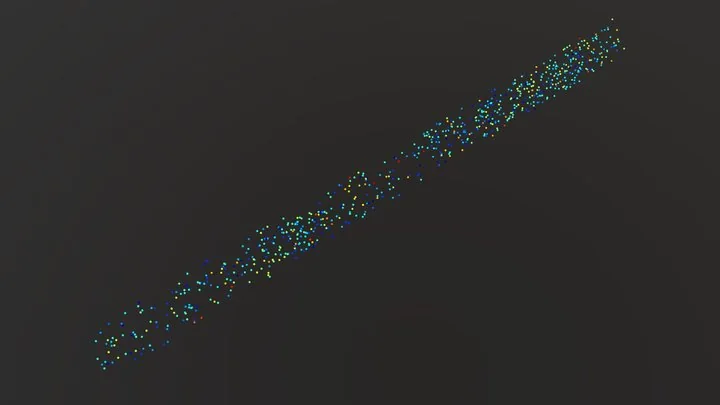
Non-uniform droplet distribution
An observed sample with visibly denser and sparser regions of droplets within the measured volume.
Drag to rotate · Scroll or pinch to zoom
The Sketchfab 3D viewer connects only after you select a model and press the load button.
3D models: Inyeob La · Source data: Shaw (2017), NCAR/EOL · CC BY 4.0 · License
Collaboration
Discuss research
Questions and collaborations are welcome.
Please get in touch about related modeling, observational, or laboratory research.